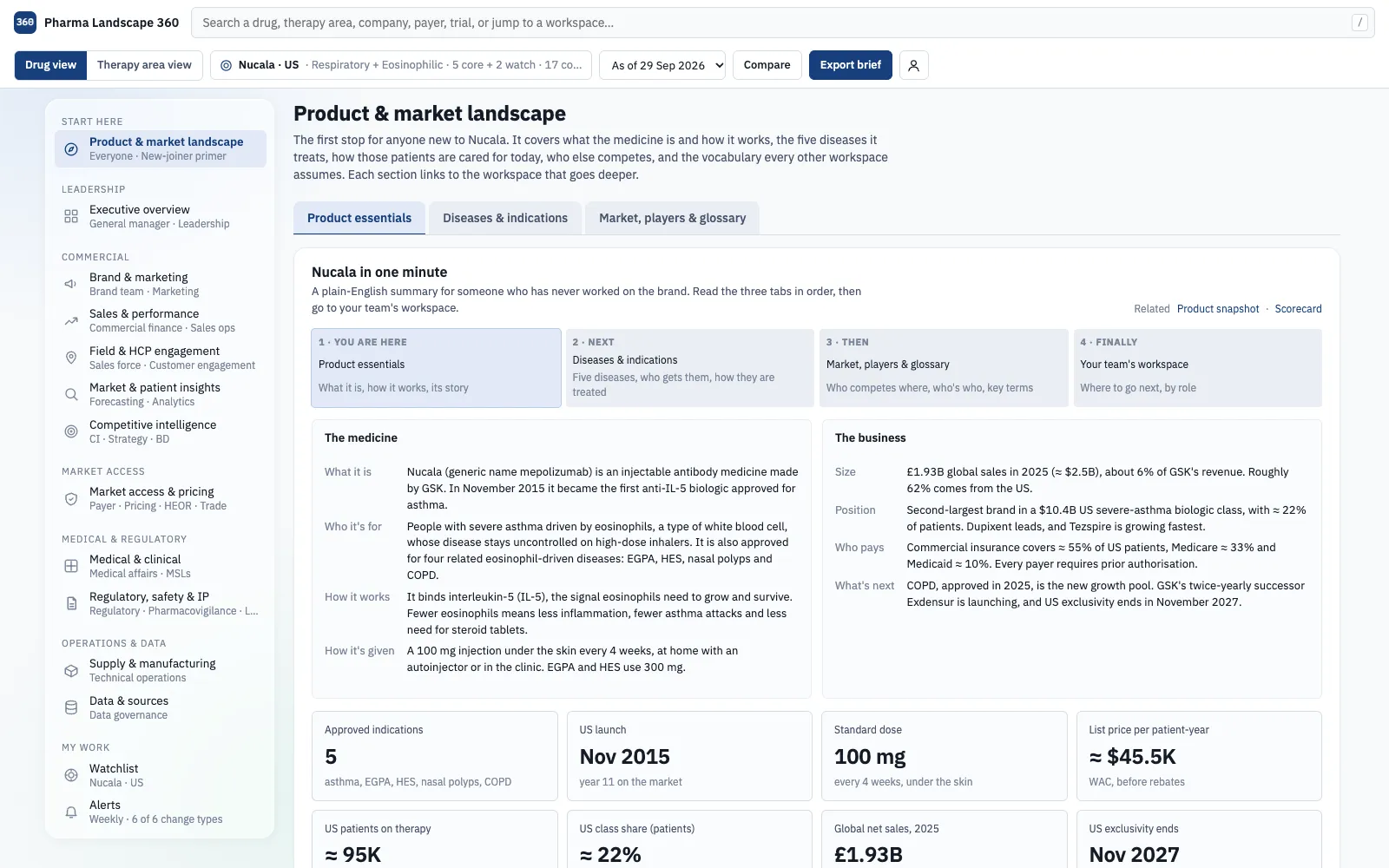
Overview
Pharma Landscape 360 is the shared intelligence layer for everyone who works on a pharmaceutical brand, turning scattered public information into one clear, connected, decision-ready picture. Today, understanding a product means stitching together sales figures, label details, payer rules, prescriber trends, pipeline news and competitor moves from sources that were never designed to work together. Every function does this separately, and every version tells a slightly different story. Pharma Landscape 360 ends that cycle. It brings the product, its diseases and patients, its sales and pricing, its coverage and access, its competitors and pipeline, its medical evidence, its regulatory and safety record, and its supply picture together in one place. Each team sees that picture through its own workspace, and every figure names the source it came from. It works for any product, in any therapy area and geography you choose. For commercial leaders, this means: - New brand, sales and access team members are productive in their first week - Every function plans from the same numbers - Competitor launches, readouts and deals are on the radar before they land - Coverage and pricing shifts are caught while there is still time to respond - Leadership briefs are ready in minutes, not assembled over days Pharma Landscape 360 doesn't just report on the market. It gives the whole organization one shared view of where the brand stands and what to do next. - Your teams stop rebuilding the same picture. - Your decisions rest on sourced facts. - Your leadership sees what changed, and why it matters. - No one has to start from a blank slide again.
Core Capabilities
- Product & Market Primer for New Joiners
- Executive Scorecard & Weekly "What Changed" Digest
- Sales Performance & Market Basket Comparison
- Competitor Matrix, Pipeline & Catalyst Calendar
- Formulary, Coverage, Pricing & HTA Tracking
- Patient Funnel, Epidemiology & Forecast Drivers
- Prescriber, Speaker & Congress Insights
- Regulatory, Safety, Exclusivity & Supply Watch
Inside Pharma Landscape 360
What each part of the platform does, and what it changes for the people who use it.
A product and market primer for new joiners
Every brand has a body of assumed knowledge: the disease, the patient journey, the label, the competitors, the acronyms everyone uses without explaining. New brand managers, sales leaders and access managers usually absorb it over weeks of meetings. The primer lays it out in plain language and is kept current as the brand evolves, so a new team member can read it in an afternoon and follow the conversation on day two. Experienced colleagues use it too, when they pick up a second brand or move therapy areas.
An executive scorecard and a weekly digest of what changed
Leadership wants to know two things: how the brand is doing, and what has changed since last week. The scorecard answers the first with the handful of measures that matter for this product. The digest answers the second in a page: competitor moves, coverage changes, regulatory news, supply issues, each with a note on why it matters. General managers read it on Monday morning. Brand teams stop spending Friday afternoons rebuilding the same update.
Sales performance and market basket comparison
Track the brand's performance against the products it actually competes with, by market, over time. See volume and share trends, spot where a competitor is gaining, and compare the whole basket rather than a single line. Sales and brand teams work from the same set of numbers as finance and leadership, which ends the recurring argument about whose spreadsheet is right.
Competitor matrix, pipeline and catalyst calendar
A side-by-side matrix of your product and its competitors covers label, positioning, evidence, pricing and access. The pipeline view shows what is coming behind them, by phase and expected timing. The catalyst calendar puts approvals, readouts, patent expiries, congress presentations and deal announcements on one timeline for the next eighteen months, so the brand plan is built around events the team can see coming.
Formulary, coverage, pricing and HTA tracking
Formulary position, prior authorization criteria, step edits, pricing movements, Medicaid coverage and international health technology assessment decisions are tracked in one place and flagged when they change. Access teams know when a large payer tightens its criteria while there is still time to respond, and the commercial team can see what that means for the forecast.
Patient funnel, epidemiology and forecast drivers
Follow patients from prevalence through diagnosis, treatment, line of therapy and switching, and see where they are gained and lost along the way. Put that next to the assumptions behind the forecast, so the team can tell which lever actually moves the number. Brand planning and forecasting end up with a shared model rather than two separate ones.
Prescriber, speaker and congress insights
Understand who is prescribing, who is speaking on the disease and on the competition, and what is being presented at the congresses that matter for the brand. Field and marketing teams see which voices are shaping the conversation, and medical colleagues see the same picture from their side of the house.
Regulatory, safety, exclusivity and supply watch
Label changes, safety communications, exclusivity and patent timelines and supply disruptions for your product and its competitors are monitored continuously. The team hears about a competitor's boxed warning or an approaching loss of exclusivity from the platform, not from a customer.
Why Teams Choose Pharma Landscape 360
Up to Speed in Days
A plain-English primer explains the product, the diseases it treats, who competes with it and the vocabulary everyone else assumes, so new joiners contribute in their first week.
One Shared Source of Truth
Brand, sales, access, medical and leadership all work from the same numbers, and every figure shows where it came from, so meetings debate decisions instead of data.
See Competitors Coming
A side-by-side competitor matrix, pipeline view, deal tracker and 18-month catalyst calendar keep launches, readouts and patent expiries firmly on the radar.
Stay Ahead on Access
Formulary status, prior authorization criteria, pricing trends, Medicaid coverage and international HTA decisions are tracked in one place, so access risks surface early.
Know Where Growth Comes From
Patient funnels, epidemiology, lines of therapy and forecast scenarios show where new patients come from and where they are lost along the way.
Brief Leadership in Minutes
An executive scorecard, a weekly view of what changed, product comparisons and one-click export briefs replace days of deck-building.
Who uses Pharma Landscape 360
Leadership and General Managers
A scorecard that fits on one screen, a weekly page on what changed, and briefs that are ready when the board meeting is moved forward. The picture the leadership team sees is the same one the brand team is working from.
Brand, Marketing and Sales
One shared view of the product, the market and the competition. Positioning, messaging and targeting decisions start from the same facts, and a new member of the team is contributing in their first week.
Market Access, Pricing and HEOR
Coverage, criteria, pricing and HTA decisions tracked together and flagged when they move, so access risks are found early and the value story stays current.
Competitive Intelligence and Strategy
A living competitor matrix, a pipeline view and a catalyst calendar the whole organization can see, which frees the CI team to do analysis instead of assembling updates.
Medical, Regulatory and Safety
Label, safety and regulatory developments for the brand and its competitors, in the same place the commercial team is looking, so both sides of the house are reading from the same page.
Forecasting, Analytics and Supply
A patient funnel and the assumptions behind the forecast in one model, with supply and exclusivity events on the same timeline as the commercial plan.
Common questions about Pharma Landscape 360
If yours isn't here, ask us directly.
What is Pharma Landscape 360?
It is a shared workspace that gives everyone who works on a pharmaceutical brand one current picture of the product, its market, its payers and its competitors. Brand, sales, access, medical, analytics and leadership each get a view built around their own questions, and the underlying picture is the same for all of them.
Which teams get the most out of it?
Brand and marketing teams use it most days. Market access and competitive intelligence teams rely on the tracking and the calendar. General managers and franchise heads use the scorecard and the weekly digest. New joiners in any of those roles start with the primer.
Does it work for our therapy area and our markets?
Yes. It is set up around the product, the competitors and the geographies you choose, and it works the same way for a specialty brand in one market as for a primary care product across several regions.
We already have dashboards. What does this add?
Dashboards are usually good at one thing, most often sales. What is missing is everything around it: coverage, competitors, pipeline, regulatory events, the patient funnel, and a plain explanation of what it all means. Pharma Landscape 360 brings those together in one place and keeps them current, and it sits comfortably alongside the dashboards you already have.
How long does it take to set up a brand?
Usually a few weeks from the first conversation to a team using it for real work. Most of that time goes into agreeing which competitors, payers and events to follow and who should see what.
Can a new team member really use it on day one?
That is what the primer is for. It explains the disease, the product, the competition and the vocabulary in plain language, and it is kept current as things change. It replaces the weeks people usually spend piecing things together from old decks and hallway conversations.
Is the information kept current?
Yes. Monitoring runs continuously and the weekly digest summarizes what changed. When something significant happens, such as a competitor approval or a large payer changing its criteria, the people who need to know are alerted rather than waiting for the weekly summary.
Can leadership get a briefing without asking an analyst?
Yes. The executive scorecard and the weekly digest are written to be read directly, and a brief on the brand, a competitor or a recent event can be exported in a few clicks. Analysts spend their time on analysis instead of assembling the same update each week.
Does it replace our competitive intelligence team or agency?
No. It gives them a better starting point. The routine work of tracking and assembling is handled, and the team's time goes into interpretation, scenario work and the questions that need judgment.
What about our confidential internal data?
Anything you bring in stays in your environment and is visible only to the people you allow. Nothing is shared between clients. We agree the details with your IT and compliance teams before anything is connected.