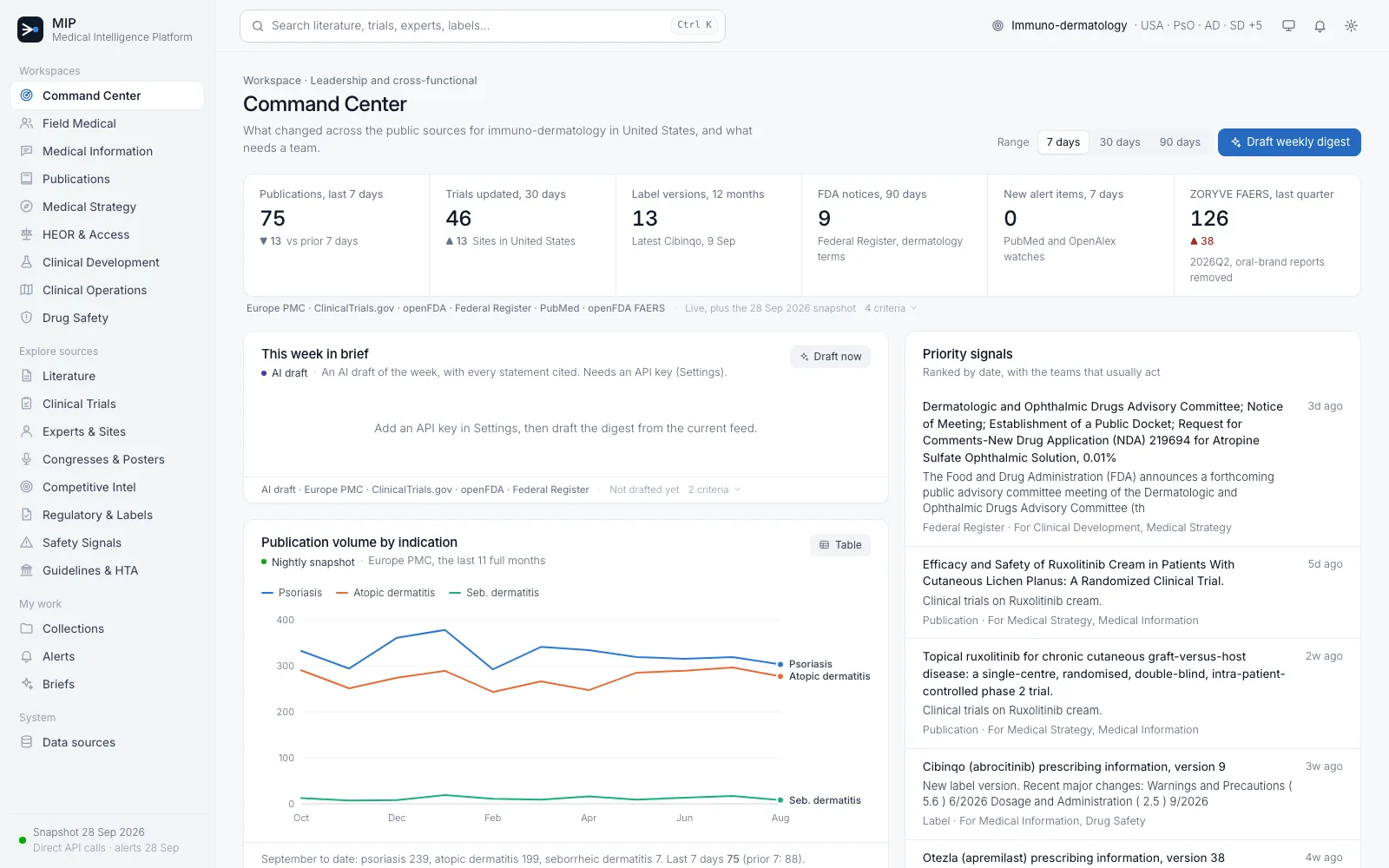
Overview
MedIntel is the medical intelligence layer that turns the flood of public scientific and competitive evidence into a clear, shared, decision-ready view. Today, the evidence your teams depend on is spread across dozens of public sources, each searched separately, by different people, in different ways. Important changes are noticed late, the same searches are repeated across teams, and hard-won findings live in personal folders. MedIntel ends that cycle. It brings literature, clinical trials, investigators and experts, congress posters, regulatory and label updates, safety reports, guidelines, HTA decisions and competitor news together in one place. Each team sees that evidence through its own workspace, and every figure, summary and AI draft points back to the record it came from. For Medical Affairs leaders, this means: - Teams learn about competitor and regulatory changes in hours, not days - MSLs arrive at every expert interaction prepared - Medical information responses are faster, consistent and fully referenced - Safety-relevant literature is screened and routed without delay - Trial planning starts from real benchmarks, not assumptions MedIntel doesn't just collect evidence. It makes that evidence shared, traceable and ready to act on. - Your teams stop duplicating work. - Your insights are defensible. - Your organization sees what changed, and who needs to act. - No one has to search a dozen websites again.
Core Capabilities
- One Search Across Literature, Trials, Experts & Regulatory
- Real-Time Alerts & a Weekly "What Changed" Digest
- Dedicated Workspaces for Every Medical & Clinical Team
- Expert & Investigator Profiles with Pre-Call Briefs
- Safety Signal Monitoring & One-Click Drug Safety Routing
- Share of Voice, Evidence Gaps & Publication Planning
- Competitive, Guideline & HTA Tracking
- AI Drafts with Every Statement Cited
Inside MedIntel
What each part of the platform does, and what it changes for the people who use it.
One search across the evidence
Ask a question once and see the answer across published literature, registered trials, congress abstracts, regulatory decisions, guidelines and health technology assessments together, rather than opening six sites and reconciling the results by hand. Search by molecule, indication, mechanism, investigator or competitor. Filter by date, phase, geography or evidence type. Save the searches your team runs every week so they refresh on their own. When everyone searches the same way, from the same place, the team stops producing five slightly different versions of the same landscape.
Alerts, and a weekly digest of what changed
Put the products, trials, experts and competitors you care about on a watchlist. When something on it moves, whether that is a new publication, a change in trial status, a label update or a regulator's decision, the people responsible hear about it that day. Everything else is gathered into a weekly digest that reads like a briefing rather than a feed: what changed, why it matters, and who on the team should look at it. Leaders skim it in ten minutes on a Monday. Nobody forwards emails anymore.
A workspace for every medical and clinical team
Field medical, medical information, publications, medical strategy, HEOR, clinical development, clinical operations and drug safety each ask different questions of the same evidence. MedIntel gives each of them a home built around their own job, with the views, saved searches and alerts that matter to them, while the underlying evidence stays shared. A medical information specialist and an MSL can look at the same trial and each see it in the form they need.
Expert and investigator profiles, with a brief before every call
Each expert profile brings together publications, trial roles, congress presentations, guideline authorship and recent activity, kept current without anyone maintaining a spreadsheet. Before a scientific exchange, an MSL opens a pre-call brief that covers what this expert has published and presented lately, what has changed since the last conversation, and which open questions are worth raising. Preparation that used to take an hour the night before now takes a few minutes, and the conversation is better for it.
Safety signal monitoring and drug safety routing
Newly published literature is screened for safety-relevant findings on the products you follow, and trends in reported adverse events are tracked over time so the pharmacovigilance team can see what is moving. If anyone on any team comes across a possible adverse event, a single click routes it to drug safety with the record attached, and the hand-off is logged. Fewer things slip through, and there is a clear trail when someone asks what was done and when.
Share of voice, evidence gaps and publication planning
See how much of the published conversation in your therapy area belongs to your product and how much to the competition, broken down by journal, congress, geography and topic. Spot the questions clinicians are asking that nobody has answered yet. Then plan the publications and presentations that will fill those gaps, with a view of where each manuscript stands. Publication teams get a plan grounded in the actual state of the literature rather than in last year's plan with the dates moved.
Competitive, guideline and HTA tracking
Competitor products, their trials, their approvals and their reimbursement decisions are tracked alongside your own, so a readout, a label change or an unfavorable HTA decision shows up in context rather than as an isolated headline. Clinical guideline updates are captured as they are published. Medical and HEOR teams can answer the question leadership always asks, which is what this means for us, without spending the afternoon assembling the background.
AI drafts, with every statement cited
When you need a digest, a briefing, a literature summary or a first draft of a medical information response, MedIntel writes one. Every sentence it produces links to the record it was drawn from, so a reviewer can check any claim in seconds. Drafts wait for a person to approve them before they go anywhere. The result is a faster first draft with less risk, not a black box that writes on your behalf.
Why Teams Choose MedIntel
See What Changed, First
New publications, trial status changes, label updates, FDA notices and competitor events surface in one weekly view, with alerts the moment something on your watchlist moves.
A Workspace for Every Team
Field Medical, Medical Information, Publications, Strategy, HEOR, Clinical Development, Clinical Operations and Drug Safety each get a home built around the questions they answer every day.
Prepared for Every Conversation
Expert profiles bring together publications, trial roles, congress activity and guideline work, and a pre-call brief is ready before every scientific exchange.
Evidence You Can Defend
Every record shows where it came from and when, and every AI-drafted digest, brief or inquiry answer cites its sources and waits for human review before it is shared.
Safety Signals, Surfaced Early
Weekly literature screening and adverse event trends help Drug Safety spot what matters, and anyone can route a potential adverse event to the safety team in one click.
Smarter Trial Planning
Benchmark trial designs and enrollment, find experienced sites and investigators, and avoid over-saturated locations before your study starts.
Who uses MedIntel
Medical Affairs Leadership
One current view of the therapy area, a weekly digest that takes ten minutes to read, and a function that has stopped duplicating its own work. When leadership asks what changed and what it means, the answer is already written.
Field Medical and MSLs
A brief before every meeting, an expert profile that stays current on its own, and a place to record what was learned afterwards. Time goes into the conversation instead of the preparation.
Medical Information and Publications
Consistent, referenced responses to inquiries, drafted faster and reviewed with every claim traceable. A publication plan built on where the literature actually stands, gaps included.
HEOR, Value and Access
Health technology decisions, guideline changes and comparative evidence in one place, ready for the value story and the payer dossier without a separate research exercise each time.
Clinical Development and Operations
Benchmarks for trial design and enrollment drawn from comparable studies, and a view of experienced sites and investigators, before a protocol is finalized and a country is chosen.
Drug Safety and Pharmacovigilance
Weekly literature screening, adverse event trends over time, and a one-click route for anyone in the company to send a possible event to the safety team, with the hand-off recorded.
Common questions about MedIntel
If yours isn't here, ask us directly.
What is a medical intelligence platform?
It is a single working environment where a medical organization keeps up with the science, the competition and the regulatory picture for its products. Instead of each person running their own searches and keeping their own notes, the whole function works from one current, shared view, and the routine monitoring happens in the background. MedIntel is built for Medical Affairs and Clinical teams in pharmaceutical and biotech companies.
Who in the company uses MedIntel?
Most often Medical Affairs, including field medical, medical information, publications and HEOR, along with clinical development, clinical operations and drug safety. Each team gets its own workspace, so an MSL and a pharmacovigilance specialist see the same evidence in the form that suits their work.
Do we have to replace the tools we already use?
No. MedIntel sits alongside your CRM, your document management system and your safety database. It is where the team goes to understand what is happening in the therapy area, and it hands off to those systems when a record needs to live somewhere else.
How quickly can a team be up and running?
A team can be working in it within a few weeks. Set-up is mostly about deciding which products, competitors, experts and topics to follow, and who should receive what. There is no lengthy implementation project and no data migration.
Will we really hear about competitor readouts and label changes sooner?
That is the main reason clients bring us in. Once the products and competitors you care about are on the watchlist, the relevant people are told the day something moves, and the rest is gathered into a weekly digest. The gap between an event happening and the right person knowing about it goes from days to hours.
Can it be set up around our therapy areas and products?
Yes. Everything is configured around your molecules, indications, competitors and geographies. Two clients in different therapy areas see very different pictures, and a team that covers several areas can keep them separate or side by side.
Is it only for large Medical Affairs organizations?
No. Smaller teams often feel the problem more acutely, because one person is covering literature, congresses and competitors on their own. A small team gets the same monitoring and the same briefs, and can add workspaces as the function grows.
Can we trust what the AI writes?
Every sentence in a draft can be traced to the underlying record, so a reviewer can check any claim in seconds, and nothing goes out without a person approving it. We designed it that way because in a medical organization a fast draft is worth nothing if it cannot be checked.
What does an MSL's day look like with it?
Before a meeting, they open a brief that covers what the expert has published and presented recently and what has changed since the last conversation. During the week, alerts tell them when something relevant to their experts or territory moves. Afterwards, they have somewhere to record what they learned that the rest of the team can see.
Does it help with medical information requests?
Yes. A first draft of a response, with references, is ready for the medical information specialist to review and edit. Answers become more consistent across the team and go out faster, and the reasoning behind each response is kept for later.
How are access and confidentiality handled?
Each client has its own environment. Access is controlled by role, every change is logged, and nothing you enter is shared with anyone else. If your organization has specific requirements, we go through them with your IT and compliance teams before anything is set up.